Republican Scott Fitzpatrick wins second term as Missouri state auditor
Published 12:22 am Wednesday, November 4, 2026

|
Getting your Trinity Audio player ready...
|
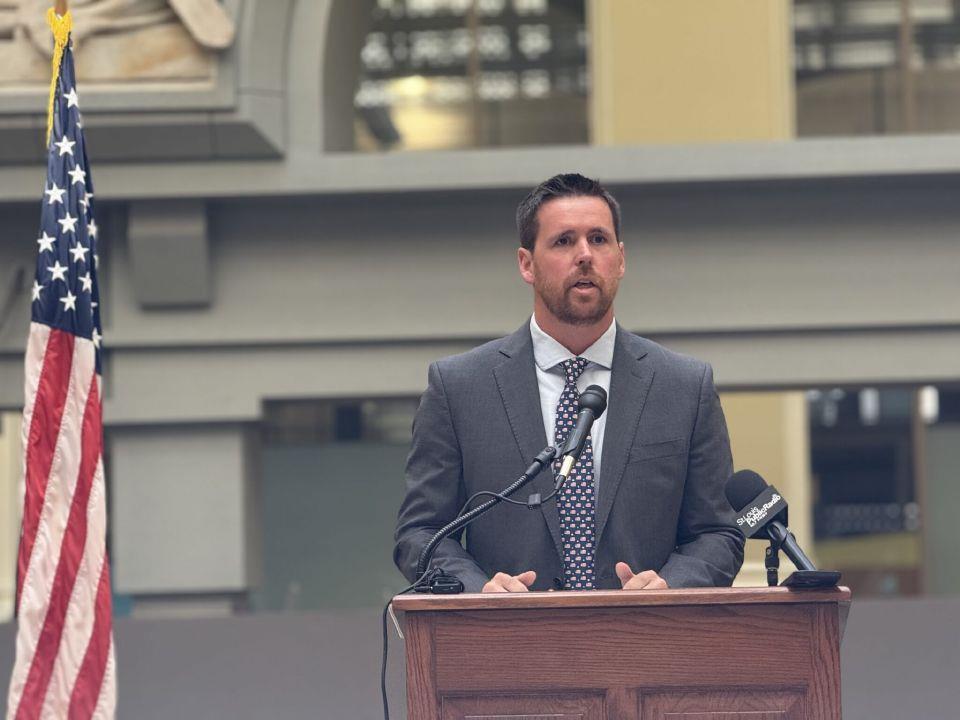
Republican State Auditor Scott Fitzpatrick won a second term Tuesday, defeating Democratic challenger Quentin Wilson in Missouri’s only statewide candidate race.
Fitzpatrick won 50% of the vote to Wilson’s 47%. Libertarian Dustin Coffell won 3%.
The victory keeps Republicans in control of all six statewide elected offices despite a historically bad Election Day that saw them lose their supermajorities in the Missouri House and Senate and a congressional seat in the St. Louis suburbs.
Fitzpatrick ran on his record of uncovering waste, fraud and abuse, particularly in local governments, and warning lawmakers about Missouri’s increasingly precarious financial outlook. The win gives him another four years to oversee the independent watchdog agency responsible for reviewing how state and local governments spend taxpayer money.
Wilson, who held leadership positions in several state agencies over two decades, argued the auditor should take a more proactive approach to helping government operate efficiently and save taxpayers money.
The contest drew relatively little attention compared with the high-profile ballot measures that dominated Missouri’s election.
But an August poll from Saint Louis University and YouGov suggested the race could be closer than expected, with Fitzpatrick leading Wilson 45% to 43%, within the margin of error.
Republicans have dominated statewide elections in Missouri for years. The last Democrat to hold statewide office was former Auditor Nicole Galloway, who left office in January 2023 after Fitzpatrick defeated her handpicked successor in the 2022 election.
Expanding the watchdog role
Fitzpatrick, a former state treasurer and chairman of the Missouri House Budget Committee, has emphasized expanding his office’s authority to investigate local governments.
In2024, he successfully pushed for legislation giving his office greater discretion to launch audits when whistleblower complaints uncover evidence of wrongdoing.
Previously, the auditor generally needed a petition from residents or an invitation from local officials to conduct an audit. The new law allows the office, under certain circumstances, to move directly from an investigation to an audit and use subpoena power during the investigative stage.
The legislation passed unanimously in both chambers.
Fitzpatrick pointed to an audit of the city of Arnold as an example of how the expanded authority has strengthened his office.
The audit released in April, found that city officials abused transportation development district laws to collect millions in sales taxes without giving residents a vote.
The report also found conflicts of interest and improper spending of district revenue on city development projects.
“The city of Arnold had basically turned this into like a forever tax or a forever district,” Fitzpatrick previously told The Independent, “where they just kind of wanted to have an open-ended list of projects that they could use this money on.”
His office also used its subpoena power to compel testimony and obtain records during the investigation.
Fitzpatrick has highlighted his office’s investigation of Jackson County’s troubled 2023 property assessments.
An audit released Friday found widespread failures in the county’s assessment process, including inadequate notification of property owners and a failure to follow state law.
Separate litigation brought by the state ultimately resulted in a settlement worth up to $250 million for affected property owners.
Fitzpatrick said he initially expected to spend most of his time auditing state agencies. Instead, his office has increasingly focused on local governments, where he said investigators have uncovered most of their fraud cases.
Missouri has more than 4,000 political subdivisions, giving auditors far more potential targets than they have resources to investigate.
“There’s always going to be more things that need our attention than we have capacity to manage at any given time,” he said.
A looming budget challenge
Fitzpatrick’s second term will also come as Missouri faces increasingly difficult budget decisions.
In a report released in December, he warned that state spending was outpacing revenue growth and could exhaust Missouri’s general revenue reserves by fiscal 2028 if existing trends continued.
The report found that the state’s general revenue balance, which peaked at $5.8 billion in 2023, had fallen to approximately $4.3 billion by the end of fiscal 2025.
“I do not see any prospects of a federal bailout coming to soften the blow of what’s about to happen this time,” Fitzpatrick told The Independent. “I think what we’re getting ready to encounter is unprecedented.”
Wilson agreed that Missouri faced serious budget problems but argued Fitzpatrick’s approach did not go far enough.
He proposed restructuring the auditor’s office to operate more like the federal Government Accountability Office, examining not only whether public money was spent properly but also whether government programs could operate more efficiently.
Wilson claimed that approach could save taxpayers as much as $1 billion annually.
He also criticized Fitzpatrick’s audits for sometimes taking too long and questioned whether the Republican incumbent was sufficiently independent of other GOP officeholders.
Fitzpatrick rejected those criticisms, arguing his office had demonstrated its willingness to scrutinize government officials regardless of party affiliation.
He also maintained that the auditor’s responsibility is to identify problems and recommend solutions, not make spending decisions.
“That’s between the legislature and the governor,” Fitzpatrick said, “and I’m neither one of those.”